
The 50/30/20 budget rule explained for beginners
Learn how the 50/30/20 budget splits take-home pay across needs, wants, and savings, and how to test your split with free budgeting tools.
Table of contents
After taxes and payroll deductions, most households benefit from a clear rule of thumb for spending. The 50/30/20 budget splits take-home pay into three buckets, a popular starting point when you’re building your first monthly plan. The framework was popularized in All Your Worth: The Ultimate Lifetime Money Plan by Elizabeth Warren and Amelia Warren Tyagi, and financial literacy organizations worldwide recommend similar category-based budgeting for households learning to manage cash flow.
This guide explains what each bucket means, walks through a real paycheck example, and shows how to test whether the rule fits your life using free tools on this site.
What the 50/30/20 rule means
The rule applies to after-tax income, the amount that actually lands in your checking account, not your gross salary on a job offer letter.
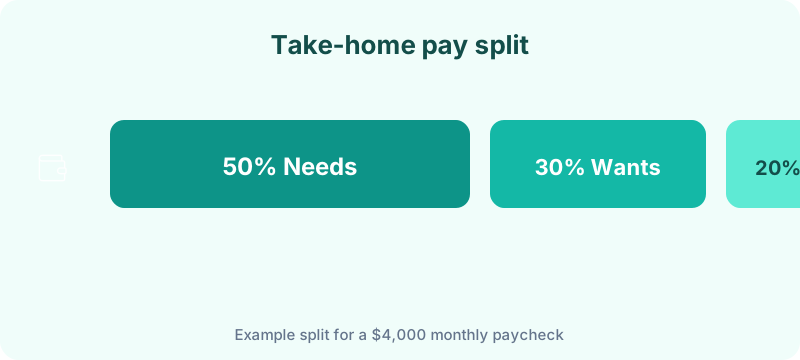
- 50% needs: housing, utilities, groceries, insurance, minimum debt payments, and other costs you cannot skip without serious consequences
- 30% wants: dining out, hobbies, subscriptions, travel, and discretionary upgrades
- 20% savings and extra debt payoff: emergency fund contributions, retirement savings beyond employer match, and payments above the minimum on high-interest debt
The rule is a direction, not a law. High-cost cities, student loans, or a single income supporting dependents may require a temporary 60/25/15 split. The point is to see whether essentials are crowding out savings before you blame yourself for “bad discipline.”
Start with your actual numbers
Pull three months of bank and card statements. Categorize every transaction honestly, including cash withdrawals and annual subscriptions prorated monthly. If your needs exceed 50%, that is useful data. It tells you whether to reduce fixed costs, trim wants, or accept a temporary split while you pay down debt.
Run your totals through the Spending Analyzer for a fast income-versus-expenses check. Then break categories down in the monthly budget template . For a step-by-step walkthrough of building a full plan, see our monthly budget planner guide.
Build a deliberate monthly plan
Once you know your split, assign every unit of income a role in the budget planner : fixed costs, variable spending, and planned savings. A positive monthly surplus means the plan fits. A negative number means adjust before the month starts, not after you’ve overspent.
Automate the savings slice
Pay yourself first by scheduling transfers on payday. When savings leave your checking account automatically, the 20% bucket becomes the default instead of an afterthought. Research consistently finds that households with higher liquid savings report lower financial stress. Automation is one of the most reliable ways to build that buffer.
Common mistakes to avoid
- Ignoring irregular expenses: car maintenance, gifts, and annual insurance premiums should live in a sinking fund inside the needs bucket.
- Comparing your split to someone else’s: life stage, income stability, and local cost of living change the math.
- Budgeting from gross pay: always use take-home income. If you’re unsure of your net figure, run your paycheck through the salary breakup analyzer guide first.
- Treating minimum debt payments as savings: minimum credit card and loan payments belong in needs until balances are gone.
- Setting wants too low to feel “disciplined”: an unrealistic wants bucket fails by week two. Budget for real life, then trim gradually.
Worked example: $4,200 monthly take-home pay
Suppose your household deposits $4,200 per month after taxes and payroll deductions.
| Bucket | Target % | Dollar amount |
|---|---|---|
| Needs | 50% | $2,100 |
| Wants | 30% | $1,260 |
| Savings & debt | 20% | $840 |
A realistic needs breakdown might look like: rent $1,400, utilities $120, groceries $380, car insurance $80, minimum student loan $120. That totals $2,100, right on target.
Wants at $1,260 could cover streaming ($45), dining out ($300), gym ($60), hobbies ($155), and a $700 buffer for travel or entertainment.
The $840 savings slice might split into $500 toward an emergency fund, $200 extra on a credit card, and $140 in a retirement account. If needs run $2,350 because rent rose, you now see the tradeoff clearly: trim wants, pause some savings temporarily, or hunt for a housing adjustment.
If your wants bucket feels vague, map dining, travel, and entertainment in the lifestyle cost planner to see discretionary spending as a share of income. The 30% target is easier to hit when you know which wants consume the most room.
When the 50/30/20 rule doesn’t apply
This framework assumes relatively stable income and moderate fixed costs. It may not fit if:
- You’re in high-cost housing: rent or mortgage alone can exceed 30% of take-home pay in many major cities, pushing needs above 50% through no fault of your own.
- You’re aggressively paying off debt: directing 30% or more to debt payoff is a valid short-term strategy that temporarily breaks the 20% savings cap.
- Your income is highly variable: freelancers and commission earners should budget from a conservative monthly baseline, not your best month.
- You’re covering dependents on one income: childcare, medical costs, and larger grocery bills often require a custom split.
In those cases, use the percentages as a diagnostic, not a grade. The goal is visibility, not perfection.
Mini-FAQ
Can I use 50/30/20 if my rent alone is 40% of take-home pay? Yes, as a diagnostic. Your needs bucket will exceed 50%, which tells you to trim wants, seek housing adjustments, or accept a temporary split like 60/25/15 while you stabilize. The rule shows tradeoffs clearly; it does not grade your worth.
Does the 20% savings bucket include workplace pension contributions? Count employer match and your own retirement contributions toward the 20% if they come from take-home pay or represent new savings. Payroll deductions already removed from your deposit are part of the picture when you measure total savings rate.
Should groceries be needs or wants? Groceries are needs. Restaurant meals and delivery are wants. Split the difference in your monthly budget template if one grocery line mixes both.
How often should I recalculate my split? Revisit quarterly, or after any raise, job change, move, or new debt. A split that worked at $3,800 take-home may break at $4,200 if lifestyle expanded with income.
Sources and references
- Warren, E., & Warren Tyagi, A. (2005). All Your Worth: The Ultimate Lifetime Money Plan. Free Press. Original popularization of the 50/30/20 framework.
What to do next
Revisit your split quarterly or after any major income or housing change. When the 50/30/20 framework fits, increase planned savings or redirect surplus toward a named goal. A budget is not a punishment. It is a feedback loop that helps you fund what matters.